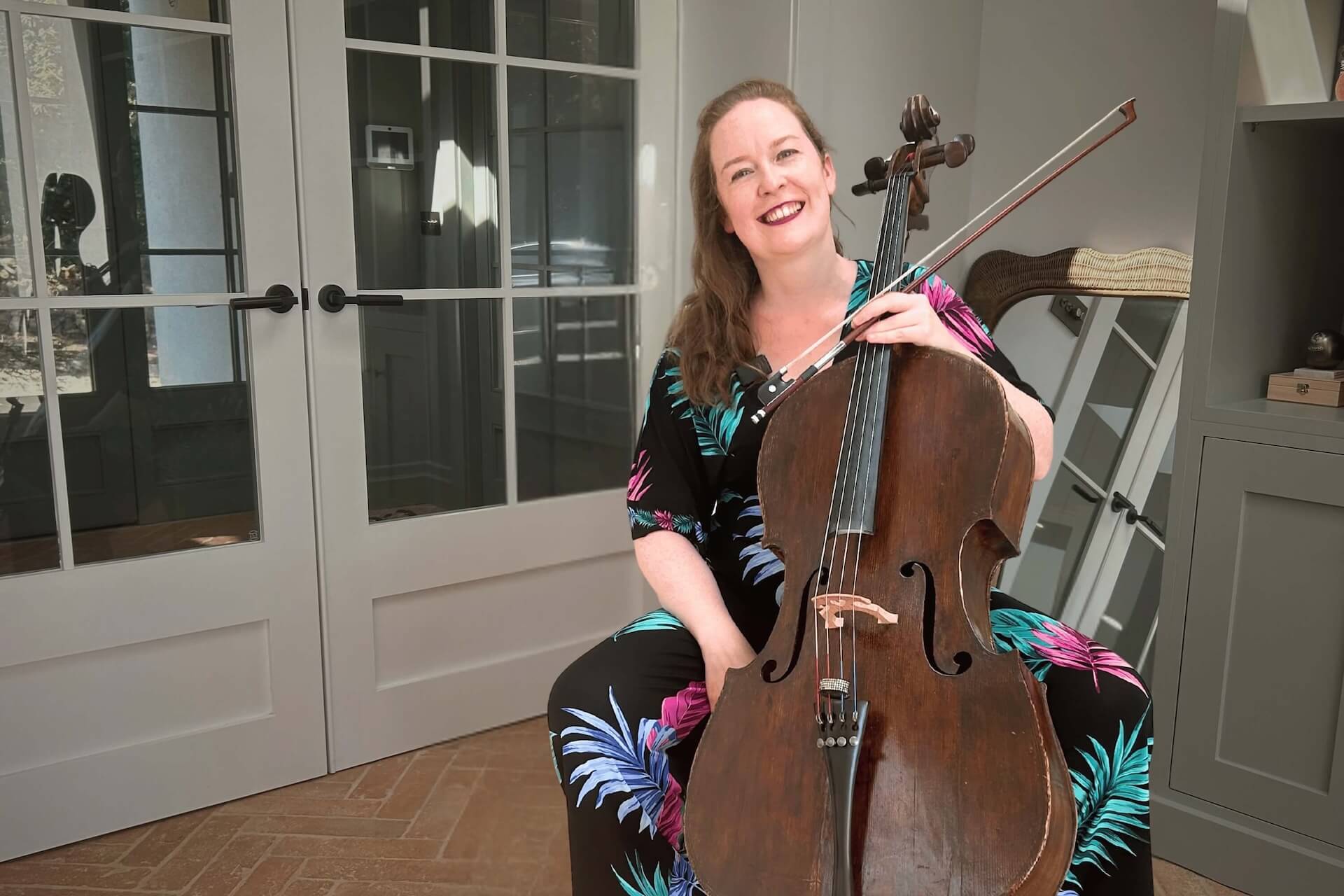
Cello Intermediate
Take the next step. Introduction to vibrato, shifting, extensions, and complex bowing.
Chapters in this series
Cello Intermediate Intro: About My Cello Teaching Video Series
Ailbhe introduces the new Cello Intermediate video series. Discover the cello pedagogy roadmap for the next level of your cello journey.
Cello Intermediate 01: Introduction to Vibrato (part 1 of 3)
The secret to a beautiful vibrato starts in the elbow. Learn the "door handle" concept, how to support your 3rd and 4th fingers, and the essential "polishing the fingerboard" exercise.
Cello Intermediate 02: Introduction to Vibrato (part 2 of 3)
Moving from mechanics to sound. Learn to "polish the string," master the "plant" exercise to find your pitch center, and why a slow "ambulance" siren is the perfect vibrato starter.
Cello Intermediate 03: Introduction to Vibrato (part 3 of 3)
Refine your vibrato speed and intonation. Learn why you should vibrate "into" the pitch (from below) and use the "pulse" exercise to gain control over your oscillation speed.
Cello Intermediate 04: Tuning Practice & Focus
Learn how to really zone in on your tuning using "double stops" against an open string. This lesson covers listening for resonance, adjusting intervals, and balancing bow weight.
Cello Intermediate 05: Introduction to Shifting (part 1 of 4)
Master the first type of shifting: "same finger" shifts. Learn to use the elbow and wrist to lift the hand, release 60% of the weight, and arrive smoothly at your new position.
Cello Intermediate 06: Introduction to Shifting (part 2 of 4)
Explore "substitution shifts," where you replace one finger with another during the move. Learn the "Newton's cradle" concept and how to transfer weight instantly to the new finger.
Cello Intermediate 07: Introduction to Shifting (part 3 of 4)
Master the "link note" shift for cleaner classical playing vs. the "giant sausage" slide for romantic expression. Learn when to use each style to suit the music.
Cello Intermediate 08: Introduction to Shifting (part 4 of 4)
Learn the secret to fast, effortless shifts. Discover how to use elbow and wrist circles to glide on the string, and master the "pin prick" shift for rapid passages.
Cello Intermediate 09: Playing in 4th Position
Learn how to start playing in 4th position. Discover how to use the cello's physical markers to find 4th position, why your finger spacing must get smaller, and how moving your bow fixes a weak sound.
Cello Intermediate 10: Left Hand Extensions
Learn the correct mechanics for forward and backward extensions, including the crucial elbow pivot, thumb release, and how to avoid left-hand tension.
Cello Intermediate 11: How to Play in 3rd Position
Discover how 3rd position unlocks smoother, more legato playing. Learn the difference between lower, upper, and extended 3rd position.
Cello Intermediate 12: How to Play in 2nd Position
Master the space between 1st and 3rd position! Learn the "Lego brick" method to easily find lower and upper 2nd position, and discover how to practice it tension-free using natural harmonics.
Cello Intermediate 13: Playing in Half Position
Learn how to play in half position on the cello with Ailbhe McDonagh. Master the "Lego brick" analogy, learn the notes, and perfect your C-shape shift.
Cello Intermediate 14: One Octave Scales with Extensions
Discover the best way to master forward and backward extensions! Learn how to practice 1-octave scales in B flat, E flat, A, and D major using two different extension techniques.
Cello Intermediate 15: One Octave Minor Scales
Learn the difference between major and minor, how to play both melodic and harmonic minor scales, and how to master the dramatic extensions at the top of the fingerboard.
Cello Intermediate 16: Two Octave Scales
Learn how to play 2-octave scales in C, D, F, and G major in the cello. Discover the secret to recognising fingering patterns and master the substitution shift.
Cello Intermediate 17: Improving Your Sound Quality
Struggling with a weak or scratchy sound? Discover the secrets to a rich, resonant cello tone. Learn the "peanut butter" technique, how to stop thumb tension, and the relationship between bow speed, weight, and contact point.
Cello Intermediate 18: Bow Change Exercises
Discover the mechanics of a truly smooth bow change, including pronation, the "brush" finger technique, and specific finger-lifting exercises to build right-hand control.
Cello Intermediate 19: The Bow Second Game
Stop running out of bow! Learn "the bow second game," a metronome exercise designed to give you total control over your bow speed, distribution, and contact point.
Cello Intermediate 20: More Bow Distribution
Learn how to adapt your bow speed, manage right-hand weight to avoid "swells" at the heel, and distribute your bow perfectly for musical phrasing.
Cello Intermediate 21: Practising Bow Slurs
Learn how to practise slurs using your scales. Discover the secret to managing "sneaky" string crossings, uneven rhythms, and naturally slowing your bow speed.
Cello Intermediate 22: Introduction to Double Stops
Unlock the full, rich sound of the cello with double stops! Discover how to balance bow weight, manage string crossings, and voice your melodies over harmonies without adding excess tension.
Cello Intermediate 23: Introduction to Chromatic Scales
Discover how to map the cello fingerboard! Learn the "Lego brick" method for mastering semitone spacing, how to transition between half and second position, and how to practise chromatic scales on every string.
Cello Intermediate 24: Improving String Crossings
Take your string crossings to the next level. Discover how to play slurred string crossings using a fluid figure of eight motion, and learn why pivoting your bow arm is essential for maximum resonance.
Cello Intermediate 25: Introduction to Natural Harmonics
Discover the fluty, ethereal sound of natural harmonics. Learn how to divide the string, master the "transfer" technique for slurs, and use these to improve your overall bow resonance.
Cello Intermediate 26: Introduction to Artificial Harmonics
Unlock the ability to play harmonics anywhere on the fingerboard. Learn the "sinking" thumb technique, how to voice artificial harmonics, and how to mix them with natural harmonics for a luscious sound.
Cello Intermediate 27: How to Play Bass Tango
Master the tango flare! Join Ailbhe McDonagh for a masterclass on her piece "Bass Tango," covering advanced articulation, crisp semiquavers, and how to perfectly count triplet crotchet rhythms.
Cello Intermediate 28: Introduction to the Tenor Clef
Bridge the gap between bass and treble clef! Discover why cellists use the tenor clef, learn essential anchor points like Middle C and open A, and master the clever "fifth up" reading trick.
Cello Intermediate 29: Introduction to Thumb Position
Venture into the upper fingerboard with confidence! Discover how to find thumb position using the octave harmonic, keep your hand curved and relaxed, and master the four primary finger spacing shapes.
Cello Intermediate 30: Off the String Staccato
Discover how to make your bow bounce naturally! Learn the fundamentals of off the string staccato (spiccato), finding your bow's balance point, and building wrist flexibility for effortless bouncing strokes.
Cello Intermediate 31: Ricochet Bow Stroke
Learn the exciting ricochet bow stroke! Explore how to throw the bow onto the string to create crisp, rebounding staccato notes, discover the quick bow-hair tension trick, and practise the rhythm with Ailbhe's piece "Fandango."
Cello Intermediate 32: Introduction to Ševčík
Unlock one of the most famous methods for string players! Discover how to navigate Otakar Ševčík's system of bowing variations to build exceptional bow speed control, tone consistency, and articulation.
Cello Intermediate 33: Introduction to Feuillard
Explore Louis Feuillard's essential studies for cello! Discover how Étude No. 1 trains independent finger action for trills, and how Étude No. 3 develops compact, efficient string crossings.